Process Safety time is the minimum time the process takes to move from its condition when the initiating event occurs to its condition when it will cause consequence of concern or simply its the time between the initiating event and the consequence occurring.
Process Safety Time (PST) is the time between the occurrence of a initiating event (failure or abnormal condition) in a process and the point at which the situation becomes unsafe, potentially leading to a hazardous event. This time interval is crucial for activating safety systems to prevent accidents and protect people, equipment, and the environment.
In functional safety, PST is determined to ensure that safety measures, such as alarms, interlocks, or automated shutdowns, can respond effectively before an unsafe state is reached. Key elements include:
Event Detection: Detecting the initiating failure or abnormal condition.
Response Activation: The time taken for safety systems to activate once the failure is detected.
Safe Shutdown: Bringing the process to a safe state before the PST expires.
Knowing the PST helps engineers design and configure safety systems to respond within the critical time frame. If the safety response time exceeds the PST, the safety measure may not be effective, leading to an increased risk of a hazardous event.
Rule of thumb for the Process Safety Time is that it should be less than 1/2 of the Process Safety Time.
Example:
Consider a scenario where cooling water to reactor jackets works as a cooling media to save the thermal run away reaction causing a potential fatality. Assume the reactor temperature increases extremely fast upon failure of cooling water pump, and will reach the unsafe condition within 5 minutes. So the process safety time is only, 5 minutes. This means that for any safeguard providing protection against this consequence from occurring it must be capable to detect, decide and act within 5 minutes of process safety time.
Alarm Response Time and Process Safety Time
An alarm can be considered a valid IPL only if the response time is within the available process safety time. The Process Safety time is the time between the alarm triggering and when corrective action must be completed to prevent an undesired event.
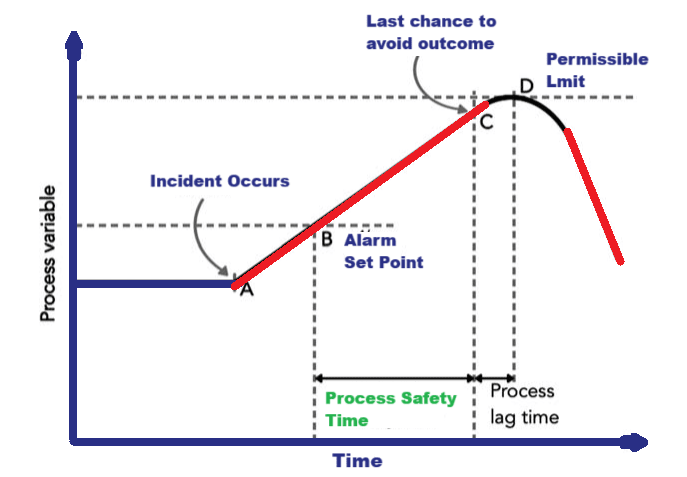
Illustration of Process Safety Time
- Point A: An Incident occurs, causing a process variable (e.g., temperature, pressure, or level) to move toward its permissible limit.
- Point B: Alarm activates, signaling the operator to take corrective action.
- Point C: is the latest possible time to complete the operator’s action if the process variable is to avoid over-shooting the permissible limit at point D.
- Point D: It is the permissible limit, where if the process variable exceeds this permissible threshold, it leads to potential failure or hazardous consequences.
- The time between points C and D is the process lag time, i.e. the time for the process to respond to the operator’s action. The curve shows the ‘worst case’ scenario in which the alarm response time is equal to the process safety time.
References:
Functional Safety from Scratch by Peter Clarke

Certified Functional Safety Professional (FSP, TÜV SÜD Germany), Certified HAZOP & PHA Facilitator, LOPA Practitioner, QRA/FERA and Specialist in SIL Verification & Functional Safety Lifecycle, with 18 years of professional experience in Plant Process Safety across Petroleum Refining and Fertilizer Complexes.