The objective of Human or Procedural HAZOP is to identify human failures during an activity and assess the potential for operator recovery or other risk reduction measures that stop this failure escalating to a major accident. When the human failure makes a significant contribution to the risk of a major accident, improvements are considered with the aim of reducing the risk of human failure to ‘as low as reasonably practicable’ (ALARP).
Key Features of Procedural HAZOP
- The techniques used are similar to those used for continuous processes, standard HAZOP procedure but with the addition of sequence and time-dependent deviations.
- Preparation work for a procedural hazop is usually more demanding than for a continuous process. The preparation work must identify the phases of the operation and plan for each phase to be explained with its design intent.
- The HAZOP should be carried out on each phase of a unit operation, and this may involve repeated examination of the same elements under different conditions based on the phase under study.
- Detailed flowcharts and functional specifications of the sequences should be made available to a study team.
- If different phases of the batch/sequential process generate different conditions, interactions with other units of the plant must be checked separately.
Methodology of Human / Procedural Hazop
A structured and qualitative risk based approach was developed for the HRA of critical procedures, referred to as a ‘Human-HAZOP’. The methodology detailed in this section is qualitative and involves a team of experienced staff, broadly following the method in HSE guidance. This is a general methodology that can in principle be applied to any operating or maintenance procedure.
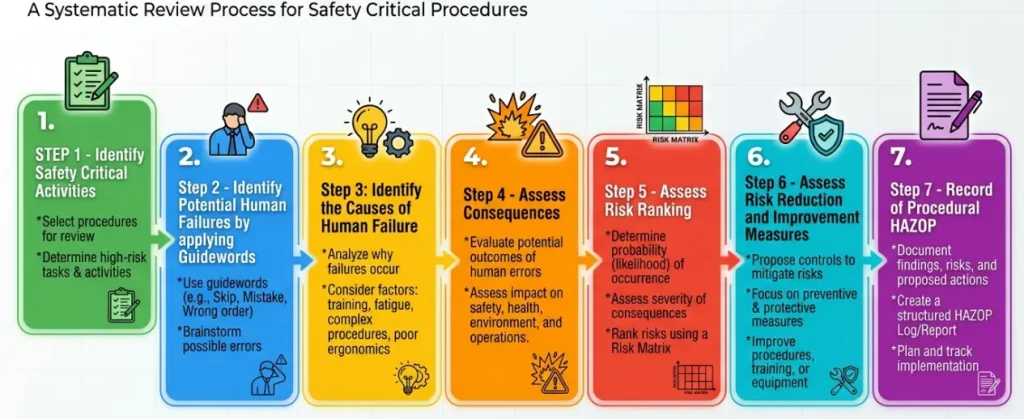
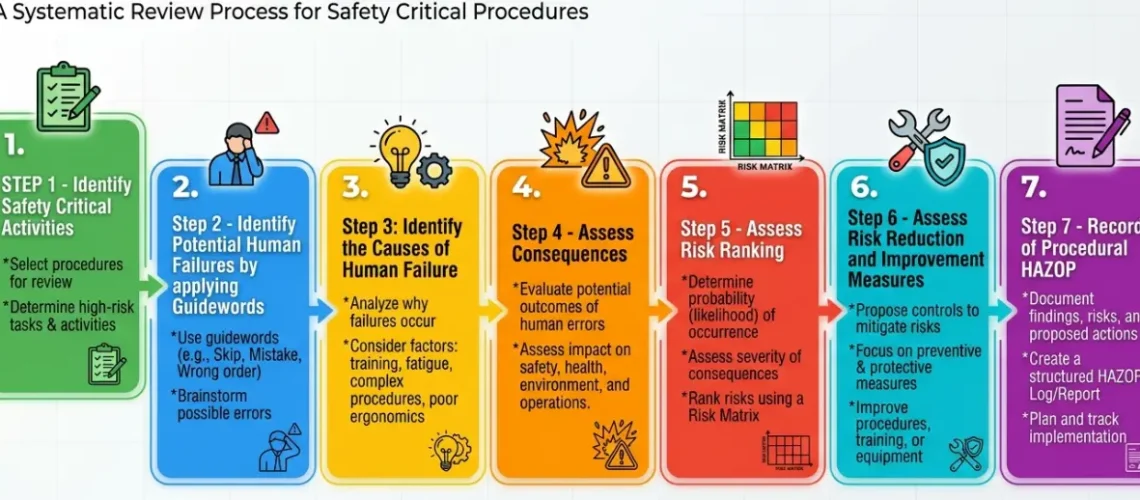
STEP 1 – Identify Safety Critical Activities
Select or identify the procedures or activities to be analyzed in Hazop study. Safety critical activities are the operating or maintenance procedures with the potential to cause major accident hazards (MAH).
As not all procedural tasks carry out major consequences, we can either conduct a comprehensive review of all the tasks in procedure or perform an initial screening can be performed to identify high-consequence activities. Any of the approaches is selected based on available resources, the number of tasks, and the team’s expertise.
The key steps in procedure are prepared in advance of the hazard identification meeting. This is done by talking to operators about how the activity is carried out in practice, watching the activity where possible, plus a review of the written procedure, checklist, job aids, training material and relevant risk assessment.
Step 2 – Identify Potential Human Failures by applying Guidewords
Procedural tasks and subtasks can be grouped as a single node for evaluation by the HAZOP team. Then guidewords for operating procedures are selected and applied to the each key step by the team to find failure scenarios, like standard HAZOP. Each guideword is accompanied by topics that might be considered and discussed in a HAZOP workshop when the guideword is applied to a key element or step in the procedure. These guidewords are like deviations as in standard hazop. Some typical guidewords for procedural hazop are follows;
| Guide word | Topics for discussion |
| No action | Step is missed or omitted; intended operation did not occur (hardware failure); action impossible; system not ready |
| More action | Operator does more than intended; other actions occur affecting this operation. |
| Less action | Operator does less than intended; hardware does not perform as required; not enough time to complete the step |
| Wrong action | Operator does the wrong thing, starts the wrong job, reads the wrong instructions; personnel perform different or out of date procedure; performs two or more steps at the same time |
| Part of action | Operator only completes part of a composite action (misses out middle part, or final part) |
| Extra action | Operator assumes something is required in addition to what is specified; other procedures interfere; other personnel in wrong area; poor communications; others don’t perform as required; a step is repeated |
| Other action | Operator misunderstands instruction and does something completely different; remembers a similar procedure and follows that instead |
Step 3: Identify the Causes of Human Failure
Causes of human failures are determined by the team, why has the operator done this wrong action? When filling out the causes and recommendations, the team must address why the human error occurred:
- Cognitive factors: Memory lapses, misreading instructions, or distraction.
- Ergonomics: Poor human-machine interface (HMI), difficult-to-reach valves, or confusing control room displays.
- Procedural clarity: Ambiguous wording in the SOP, conflicting instructions, or missing steps.
- Environment: Poor lighting, excessive noise, or high-stress situations.
Step 4 – Asses Consequences
For all credible human failures, the team assesses the initial and ultimate consequences by considering that there is no preventive or mitigative safeguards. The consequence should be described the initial effects of the error such as “level increase” or “pressure increase” and the consequent effects such as explosions, toxic release and “fire and the ultimate impacts in terms of injuries, fatalities or production loss.
Step 5 – Assess Risk Ranking
Initially assess the unmitigated risk of the scenario by considering the consequences and likelihood. Then after identifying the safeguards, mitigated risk is calculated. If the mitigated risk is still higher as per company’s criteria, the new safeguard is suggested.
Step 6 – Assess Risk Reduction and Improvement Measures
The team identifies the ‘engineered’ risk reduction measures currently in place, including inherent, passive and active protection systems. These measures should be designed to reduce the risk of the human failure to an acceptable level of risk. The team should consider improvement options to eliminate or reduce the risk associated with human failure.
The team should consider improvements for any human failures considered to present a significant risk, such as Improved or clearer written procedure. Job aids such as checklists. Clear signs at workplace. Improved training and competence of staff. Regular auditing to demonstrate compliance. Reliable and usable written procedures are important when avoiding ‘mistake’ type errors.
Step 7 – Record of Procedural HAZOP
The results of the HRA are recorded on a ‘Human-HAZOP’ record table with the following columns: Step: Description of task by person carrying out activity. Human Failure: Description of credible human failures when carrying out this task based on guide diagram
Consequences/Severity: Ultimate consequences of the human failure if there is a failure to recover or mitigate the event. Potential to recover/Likelihood: Potential for human recovery involving detection of problem, diagnosis and correction of failure. Risk Reduction Measures: Risk reducing measures to prevent escalation of the incident that do not involve human intervention. Recommendations: Practical actions to reduce the potential for failure based on the PIFs or for further risk reduction measures based on the hierarchy of measures.
Top References
- A Practical Application of Human-HAZOP for Critical Procedures, by Graeme R Ellis and Andrew Holt
- https://broadleaf.com.au
- HAZARD AND OPERABILITY (HAZOP) GUIDELINE, EGPC-PSM-GL-005 PPSM GUIDELINES, May 2022

Certified Functional Safety Professional (FSP, TÜV SÜD Germany), Certified HAZOP & PHA Facilitator, LOPA Practitioner, QRA/FERA and Specialist in SIL Verification & Functional Safety Lifecycle, with 18 years of professional experience in Plant Process Safety across Petroleum Refining and Fertilizer Complexes.